Build a Game Dev Portfolio a Reviewer Can Verify
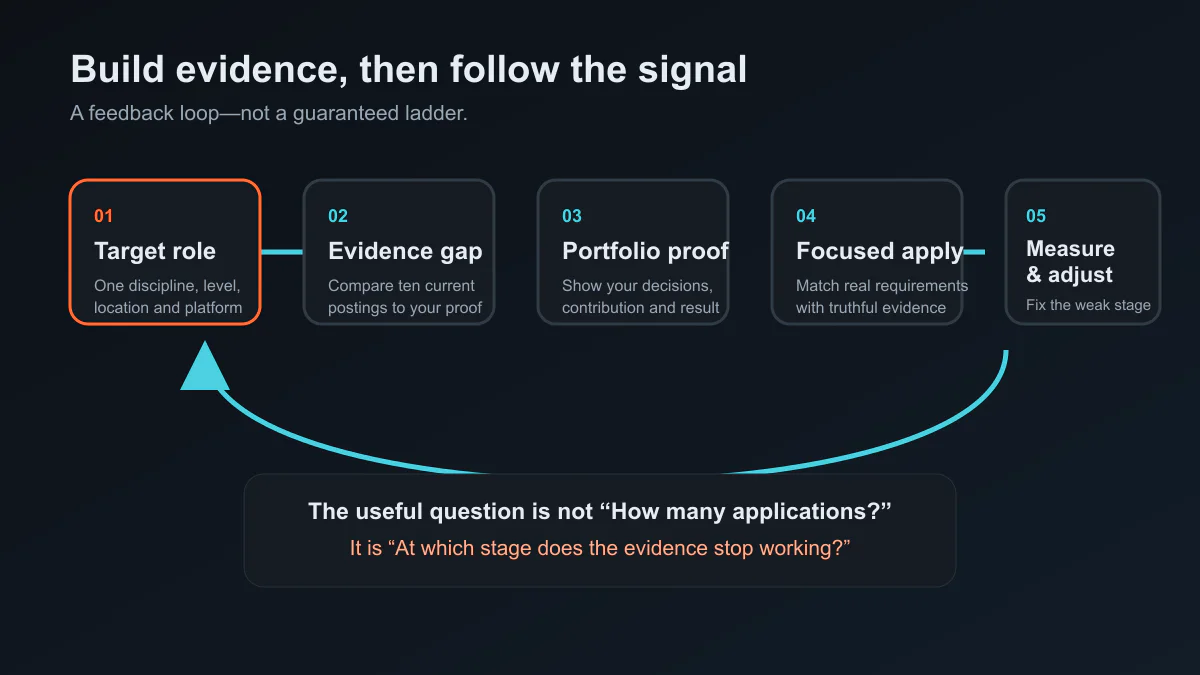
Image: GameDev Careers
No representative study shows that every game portfolio gets five seconds or that a portfolio always beats a résumé. Hiring teams, roles, and review stages differ.
The controllable goal is simpler: make the evidence relevant, accessible, attributable, and easy to verify.
Begin with the target role
Select work that demonstrates duties in the posting:
| Target role | Useful evidence |
|---|---|
| Gameplay programmer | Playable mechanic, code sample, tests, performance decisions |
| Level or systems designer | Playable sequence, goals, constraints, iteration and telemetry |
| Technical artist | Tool or shader, before-and-after workflow, performance budget |
| 2D or 3D artist | Focused work, topology or layer breakdown, references and process |
| Producer | Schedule artifact, risk decisions, communication process, outcome |
| QA | Reproducible report, test design, severity reasoning, de-identified evidence |
The number of projects is less important than the fit. One project may be enough for one question and insufficient for another.
Use a case-study structure
For each project, state:
- Brief: What problem or experience were you trying to create?
- Constraints: Time, platform, team, performance, accessibility, or tools.
- Your contribution: What did you personally own?
- Decision: What alternatives did you consider?
- Evidence: Build, video, code, images, test results, or documentation.
- Result: What happened, measured how?
- Limitations: What remains incomplete or what would you change?
Do not turn an unmeasured impression into a metric.
Make credit and provenance explicit
List teammates and their roles. Identify:
- asset-store or open-source material and its license;
- commissioned work;
- tutorial-derived components;
- generative-AI assistance and what the tool did;
- employer-owned work shown with permission; and
- confidential material removed or anonymized.
The IGDA Game Crediting Guidelines offer an industry reference for acknowledging contributions. A portfolio credit does not override a contract or grant permission to publish confidential work.
Reduce access friction safely
A browser build can be convenient, but it is not mandatory. A short captioned video, screenshots, code excerpt, or platform page may be better for large, unreleased, inaccessible, or security-sensitive work.
If you offer a download:
- identify the platform and file size;
- use a reputable host;
- avoid unnecessary installer privileges;
- provide controls and accessibility notes;
- test links in a signed-out browser; and
- keep a fallback video.
Do not imply that reviewers must run an unknown executable.
Make the page readable
Put contact details and the target discipline in plain text. Use descriptive link labels, captions, visible focus states, sufficient contrast, alt text for informative images, and a transcript for important spoken content.
The portfolio still needs an accurate résumé or application when the employer requests one. It cannot substitute for a mandatory license, work authorization, degree, or shipped-title requirement.
Final review
- Does each piece answer a requirement in the posting?
- Is your contribution unmistakable?
- Are credits, licenses, and AI use disclosed?
- Are links working without your private login?
- Can a reviewer understand the piece without audio?
- Did you remove private data and unreleased employer material?
- Are claims supportable in an interview?
Source notes
- IGDA’s Game Crediting Guidelines provide a framework for contributor credit.
- BLS’s special effects artists and animators profile notes that employers commonly value portfolios and technical skills; the occupation is broader than games.
- W3C Web Content Accessibility Guidelines provide the primary web-accessibility standard for portfolio presentation.
Source check: 27 July 2026.
This article provides general portfolio guidance, not legal advice or a guarantee of employment.
portfoliogame careershiringskills-based2026