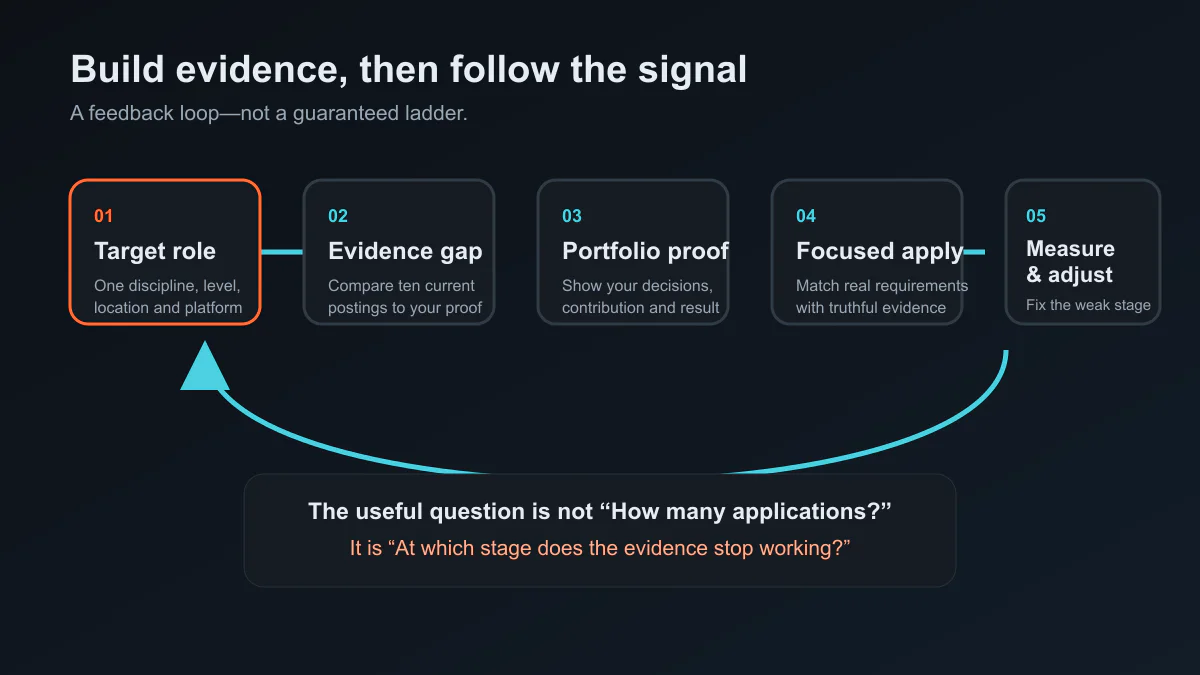
Map a Game Job to Skills Before You Apply

Game titles vary wildly between studios. “Technical designer,” “systems designer,” and “tools engineer” may overlap in one company and diverge in another. Before applying, copy the responsibilities from the actual posting and translate them into evidence you can show.
Build a three-column map
Put the employer’s responsibility in column one, the skill or tool it requires in column two, and your proof in column three. Proof might be a playable build, a before-and-after bug fix, a design document, a test plan, or a short explanation of a trade-off. If you have no proof, mark the gap rather than implying experience you do not have.
O*NET is useful as a vocabulary reference for tasks, skills, and occupation context. It is not a substitute for the employer’s posting, and it does not certify that you qualify for a specific studio role.
Make contribution visible
For team projects, identify what you owned, what you collaborated on, and what used licensed or AI-assisted material. A reviewer should not have to guess which part was yours. Add dates, constraints, and a link that works without a private account.
Primary sources
game careersskillsportfoliojob applications